
Lighting for Wildlife And Bats
Introduction
Many Species of Bat, insects and other wildlife are in danger from increasing urbanisation in general and lighting is part of the problem. Legislation protects the Roost (Resting places for Bats) from being intentionally or recklessly disturbed. If a lighting scheme is being developed in an area with Bats, a survey is carried out to plan and minimise the disruption to Bats. The survey will usually identify the type of Bat (some are more sensitive to light than others), their Roosts (there can be several and can vary at different times of the year), their foraging (feeding) area, the commuter area (between Roost and Foraging area). Ideally, these areas should not be illuminated and especially not the Roost. However, in some instances, for safety reasons for example, it may be decided that it is necessary to install lighting.
The lighting Factors which will minimise the effect on Bats are as follows:
1. REDUCE or prevent spill to any other area forming part of the Bats commute. If lighting a Pathway for example, the light ideally would be directed at the Path only, with no uplight or illumination of nearby Trees, bushes, river, waters, buildings, etc. VeeLite can design lighting schemes with Luminaires that provide no uplight, or have narrow downward beams of light, and have optics or shields that prevent backspill etc.
2. REDUCE light levels – There is no definite light level below which Bats will not be disturbed. Different species of Bat appear to show more sensitivity than others.
3. REDUCE Luminaire Height – If the Bats are commuting at a known height, it may be an option to drop the maximum height of the Luminaires (with good cut-off, no uplight, narrow beams etc) so the Bats may fly over this in a zone of relative darkness.
4. REDUCE Reflectances – Downward lighting can be reflected from bright surfaces, so using Black Tarmac instead of bright gravel or concrete for the Pathway may be a consideration. The same applies to other materials – the colour Finish on the Lights, Poles, Walls, Street furniture etc..
5. SHIELD Luminaires & Light – Adding Shields/Baffles or allowing natural objects (hedges, flowers etc) to stand between the luminaire and the flight path or Roost.
6. TYPE OF LIGHT – Warm coloured lighting (eg CCT of 2700K or below) is less disruptive than colder coloured lighting (eg. 4000K). Minimising or eliminating UV light is recommended. LED lighting has no UV. The older HPS has 0.2% and Metal Halide has 2%-7%. Generally, VeeLite will use LED Luminaires with exact cut-off optics, and warm colour temperature of 2700K or below if bats are of concern.
7. LIGHTING CONTROL – The peak time for feeding for Bats is dusk (plus say 2 hours). This is when they exit the Roost to go foraging. If the lighting was switched off for this period, or at lower light output, this would benefit the Bats. In addition, the lighting could be controlled by occupancy/motion sensors so that it would remain off/low if there was no pedestrian traffic nearby. VeeLite offer LED controls to dim or switch off lighting at off-peak, dusk, dawn, foraging hours etc.
8. There is no 1 lighting Product than can cover all situations – the best solution is planning of each lighting Project. VeeLite offer a lighting design service to provide the optimum lighting solution.
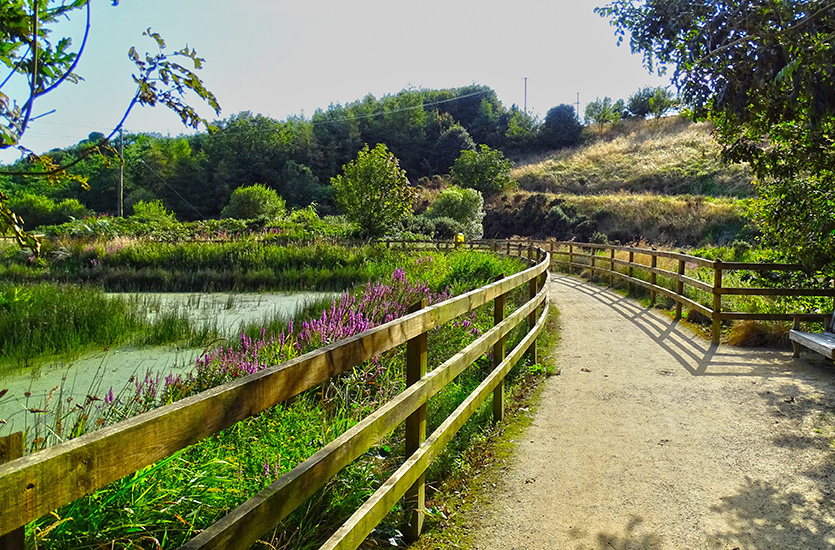
Typical Bat Habitat

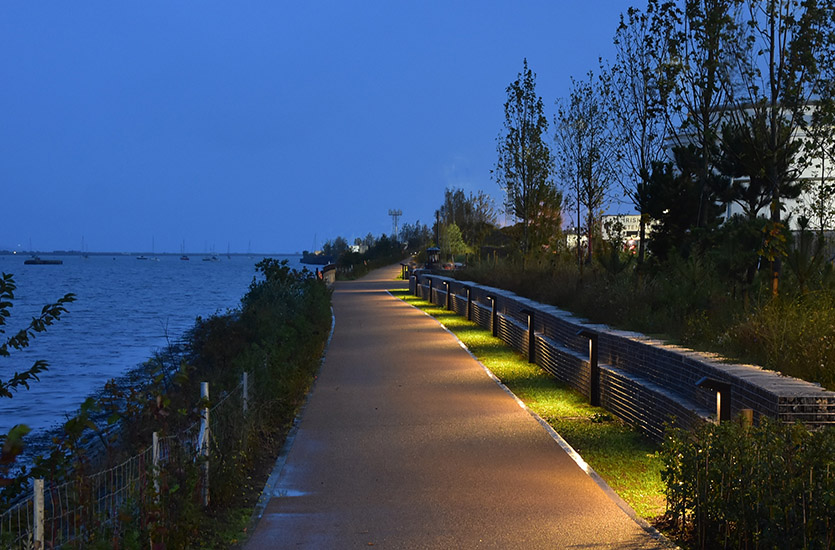
Low Height Bollards

Low Height Streetlight