

Is Your Project suitable
Solar Panels Exposed to the Sun
Solar Panels need to be exposed to the Sun, especially in Winter when the Sun is lower in the sky. When there are no obstructions in the way – Trees, Buildings, etc – the Project may be suitable for Solar.
Low Light Levels Required
Lower Light Levels are adequate for most rural areas. With less power required, the operational hours can be increased significantly.
Low Operating Hours
Low Operating Hours – where the Lighting is only required for a few hours each day (in Winter). Example, Lighting may not be needed after 7pm, 9pm or midnight, etc.
Low Traffic
Low Traffic is good for Solar as the Lighting can be dimmed to a low light output and only run at full power when a Motion Sensor detects local movement. With the power dimmed for most of the time, the operational hours can be increased significantly.
Mains Electricity Not Available
When Mains Electricity is not available, or is very expensive to access, then Solar can be a cost effective solution, especially if you only need 1 or a few Lights to power.
Summertime Use Mainly
Summertime is best for Solar – long days with bright sunshine. Winter may be ok if less operating hours are needed.
Solar Panels Obstructed
Solar Panels need to be exposed to the Sun, especially in Winter when the Sun is lower in the sky. When there are obstructions in the way – Hedges, Trees, Buildings, etc – the Project is generally unsuitable for Solar.
Higher Lighting Levels Required
Higher Lighting Levels are required in Urban areas or areas with higher traffic.
High Operating Hours
High Operating Hours – (eg. all Night in Winter) is less suited to Solar as not enough Energy is generated during the day.
Busy Areas
Busy areas (higher pedestrian or vehicle traffic) are not so suitable for Solar as there is limited opportunity for Motion Sensors to dim the Lighting to a low output.
Mains Electricity is available
When Mains Electricity is available, then there is usually no economic justification for using Solar.
Winter Time Usage
Winter is less suited to Solar as not enough Energy is generated during the day.
Solar Streetlights, Solar Area Lighting, and Solar Walkway Lighting are popular sustainable solutions for outdoor lighting. These systems typically use solar panels to capture and store energy during the day, which is then used to power efficient LED lights at night. VeeLite designs the optimal solar lighting solutions using advanced software to ensure the minimum number of lights are installed while maximizing light levels and coverage, thus minimizing energy consumption.
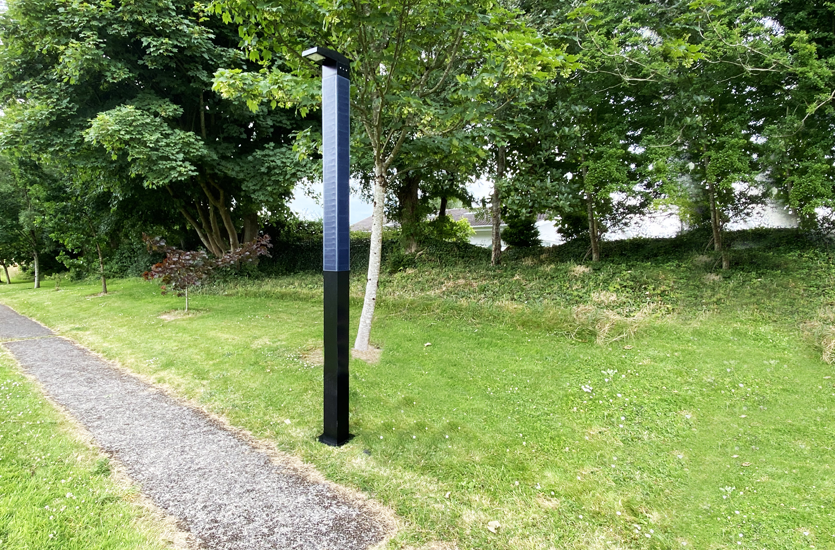
For Walkways and Pathways, Solar Walkway Lighting is a common choice, where solar-powered LED fixtures are strategically placed to provide even illumination across the area. Solar Streetlights are ideal for illuminating larger streets and open spaces, while Solar Area Lighting is perfect for providing broader coverage in areas like parking lots, parks, and plazas. VeeLite’s approach typically involves maximizing the spacing between poles while ensuring that light levels are adequate for safety and visibility. In many cases, VeeLite uses spacings of up to 40 meters or more between solar-powered light poles. Several other configurations and options are available, depending on the specific requirements of the site.